Industrial logistics hubs, automated distribution centers, and high-output manufacturing facilities rely heavily on the geometric flatness and structural integrity of their concrete floor systems. Over years of heavy forklift traffic, thermal cycling, and foundation settling, commercial slabs frequently develop uneven joints, curling edges, high spots, and trip hazards that disrupt automated guided vehicles and damage high-reach material handling equipment. Correcting these surface irregularities without undertaking costly full-depth slab replacement requires specialized mechanical surface profiling and high-precision structural separation techniques. General contractors and facility managers solve these complex floor remediation challenges by integrating controlled surface milling with engineered cutting solutions to restore operational tolerance and prepare slabs for modern industrial loads.
To eliminate raised slab joints, uneven floor transitions, and surface imperfections across large commercial expanses, facility engineers utilize advanced concrete shaving methodologies. Unlike traditional abrasive floor grinding that polishes the top layer slowly, mechanical concrete shaving employs high-torque, diamond-tipped drum assemblies designed to plane down high spots and calibrate floor elevations with millimeter accuracy. Riding on precision-leveled tracks or laser-guided control systems, shaving machines remove specified depths of concrete aggregate in a single pass, creating a flat, uniform surface profile that meets stringent F-number flatness and levelness specifications. This process also creates an ideal mechanical bond profile for subsequent epoxy coatings, polyurea joint fillers, or industrial floor sealants, extending the service life of high-traffic warehouse floors without halting adjacent facility operations.
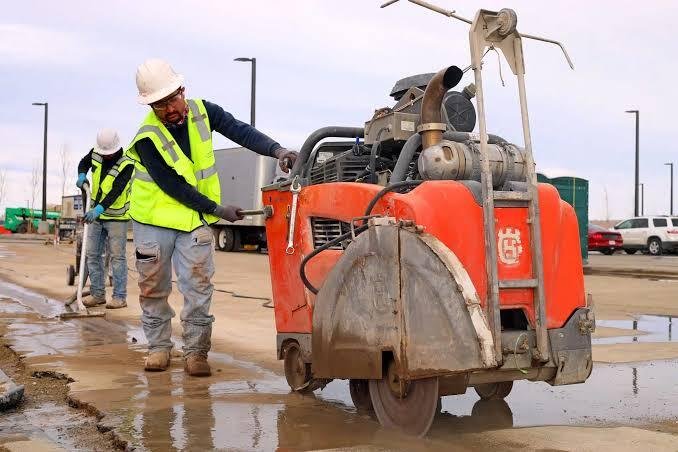
When floor remediation, utility trenching, or structural expansion requires separating slab panels, installing expansion joints, or isolating vibrating machinery foundations, project teams deploy certified concrete cutters equipped with high-output diamond saw systems. Industrial flat saws, wall saws, and wire saws utilize continuous water-cooled diamond blades that slice cleanly through high-PSI concrete and dense steel reinforcement. Precision saw cutting establishes straight, clean isolation boundaries around damaged slab sections prior to removal, ensuring adjacent structural concrete remains completely free from impact fractures or edge spalling. Additionally, cutting deep control joints into newly poured or retrofitted slabs relieves internal tensile stresses caused by concrete shrinkage, preventing random structural cracking across expansive warehouse floors.
Executing precision surface shaving and deep structural cutting inside active commercial facilities requires strict adherence to environmental containment and subsurface safety protocols. Before initiating mechanical milling or deep slab sawing, certified technicians scan target floor zones with Ground Penetrating Radar to verify the depth of top-layer rebar grids, post-tension cables, and shallow electrical conduits. Mapping internal structural elements guarantees that diamond drum teeth and saw blades operate strictly within safe depth tolerances. Simultaneously, professional crews connect cutting and shaving equipment directly to industrial HEPA-filtered vacuum extractors and closed-loop slurry collection systems. Capturing crystalline silica dust and wet concrete residue at the point of generation ensures complete compliance with OSHA respiratory safety regulations and prevents airborne particulates from contaminating sensitive inventory or manufacturing equipment.
Ultimately, maintaining high-performance industrial floor infrastructure demands a proactive approach that combines precision elevation correction with clean structural jointing. By partnering with experienced specialists who deploy laser-guided shaving drums, high-torque diamond sawing fleets, non-destructive subsurface radar diagnostics, and source-capture dust containment systems, commercial facility managers can restore critical floor tolerances, protect material handling equipment, and complete complex structural upgrades safely and efficiently.